Singles and Doubles: Two Different Ways to Read the Same Court
Singles and doubles court positioning change who covers each reply. Learn how to choose a target, share the middle and prepare for the next shot.
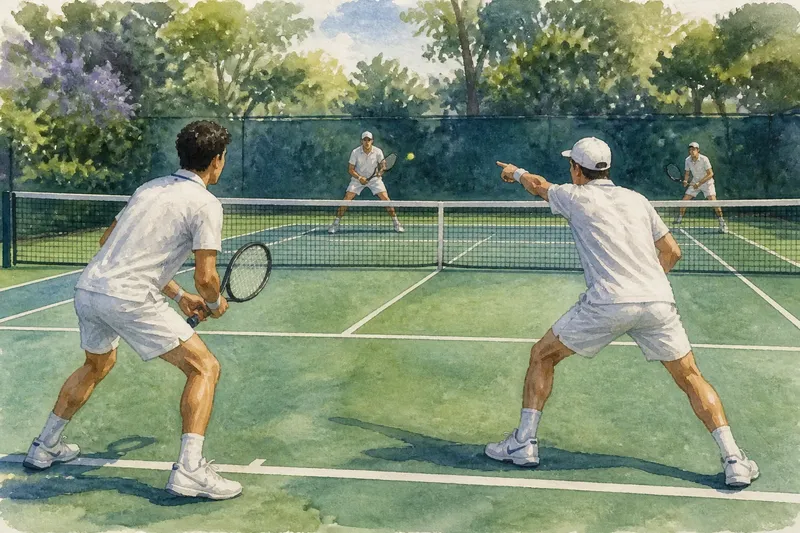
Singles and doubles court positioning call for different decisions, even when the ball lands in the same place. In singles, you must cover the space yourself; in doubles, you also need to account for your partner and two opponents. The difference changes which shot is sensible and where you should move next.
Use the ball’s direction, the opponents’ positions and your own balance to make the decision. In doubles, add one question: who is best placed to take the likely reply? That is more useful than memorising a fixed position for every situation.
Managing wide balls
When you are pulled wide in singles, a difficult winner is rarely the only option. If your balance is poor, send a controlled ball with enough height and depth to make the opponent play again. That gives you time to move towards a position from which you can cover the next shot.
In doubles, resist chasing across the court if your partner is already set to cover the ball. Call early if responsibility is unclear. A ball down the middle should not turn into a collision or a gap because both players waited for the other to move.
Say you are stretched wide in singles, and your opponent is balanced near the centre. You choose a safe cross-court reply rather than trying to reach the sideline. The expected result is a rally ball that gives you time to regain balance; the trade-off is that the opponent may still attack, so be ready for the next shot.
Sharing the middle
Before a doubles match, agree who prefers to take a ball through the middle. A player’s reach, forehand and position can all matter, so avoid treating one rule as right for every pair. Use a clear call such as “mine” or “yours” as the ball approaches.
If neither player has a clear advantage, decide between points how to handle that situation next time. During the rally, make the simplest available choice rather than trying to negotiate aloud at the last moment.
In singles, the middle is a reference point, not a fixed recovery spot. Move to a position that accounts for where you hit from and the opponent’s likely replies. If you sent the ball wide and the opponent is set to play across court, favour that route without abandoning the other side completely.
Choosing when to poach
A doubles player at the net should not reach across for every ball. Move to intercept when you can make a controlled volley and your partner can cover the space you leave. If the ball is travelling deep towards your partner or the opponent has a clear passing angle, hold your position instead.
In singles, approaching the net has a different cost because no partner is behind you. Move forward when your shot makes the opponent’s passing options difficult, not simply because you hit from inside the baseline. A safe volley that leaves you badly placed can still invite a difficult reply.
Finding a useful target
Do not send every ball to a favourite patch of court. In singles, moving the opponent can open space for your next shot, but the first ball need not be a winner. In doubles, check whether the net player can intercept and whether the baseline player can reach the space you are targeting.
Choose a direction that fits your balance and the space you can see. A controlled shot that makes an opponent move is usually a more practical choice than a sharp angle attempted from an unstable position. You do not need to disguise every shot.
Positioning questions?
Where should I recover in singles?
Move to a position that gives you a realistic chance against the opponent’s likely replies, based on your shot and their location. Use the centre as a guide rather than a compulsory destination.
Who takes a ball down the middle in doubles?
Agree a preference before play, then let reach, balance and court position settle close calls. Call early so both players can move decisively.
Should a doubles player always poach?
No. Intercept when you can reach the ball under control and your partner can cover the space you leave. Otherwise, stay ready to protect your area.
Is the singles court smaller?
The singles court is narrower than the doubles court, while both have the same length. Doubles includes the alleys, so players have more width to cover.
Practising the read
Use a cooperative rally to practise making decisions before adding pressure. From the baseline, call the space you are aiming for before each shot. In doubles, add your partner’s name when you expect a ball may go through the middle.
- If you are stretched and off balance, choose a safer height or direction; if you are balanced, consider a more direct target.
- If your partner has the clearer reach to a middle ball, call their name and leave them room; if you have the better position, call “mine” and take it.
- If the net player can intercept your intended shot, aim elsewhere; if that player is out of reach, keep the planned target.
- If your approach leaves the opposite side exposed, hold back or choose a safer shot; if your partner can cover it, move forward.
- If your opponent is set to attack a wide reply, recover towards that route; if their position suggests another likely direction, adjust accordingly.
- If a practice call arrives too late, repeat the rally with an earlier call; if it is clear and timely, add a live point.
It is not worth memorising an elaborate pattern for every court position. Practise one decision at a time: choose a target, make the relevant call, or move into position for the next shot.
Singles and doubles court positioning differ most in who shares responsibility. In singles, your recovery must account for the space you can cover; in doubles, make the same judgement with your partner’s position and agreed role in view.