Your First Tiebreak: Keep Track of the Point, Not the Noise
Follow a tennis tiebreak by tracking the score, server and end changes, so you can understand the point at hand without memorising every scoring rule.
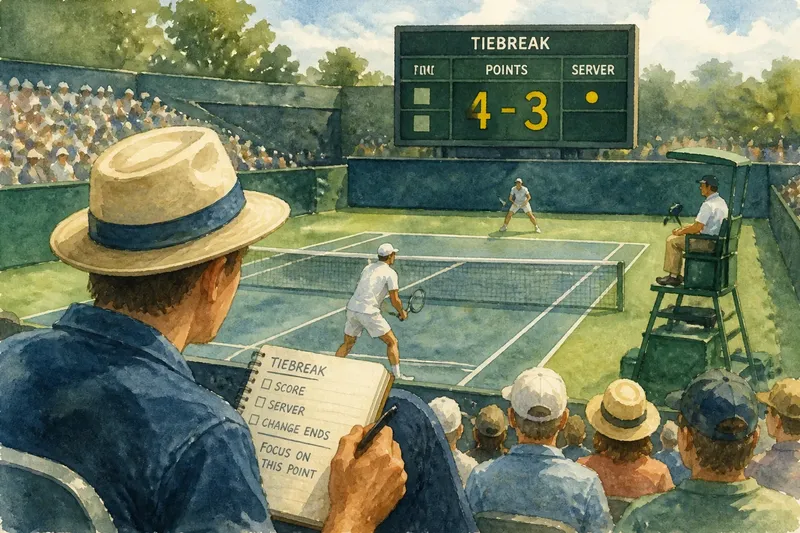
To follow a tennis tiebreak as a spectator, watch the scoreboard, identify the server and note when the players change ends. Those three cues show where the match stands without asking you to memorise every call.
The crowd may react to a long rally or a double fault, but your job is simpler: work out who won the point and what changes next. Keep your attention on those details and the pressure becomes easier to read.
Read the scoreboard
A tiebreak begins when the set reaches the score set by the competition, often six games all. The point total shown during the tiebreak is separate from the set score. If the display reads 4–3, the players have won four and three tiebreak points; it does not mean four games to three.
Listen for the umpire’s call and check the scoreboard after a rally. The call gives the server’s point total first, so identify the server before interpreting the numbers. A player who is close to the target may still need another point if the required lead has not been reached.
Some competitions use a different tiebreak format, particularly to decide a set or match. If the format is unclear, check the event’s on-court display or listen to the umpire’s explanation rather than assuming the same target applies everywhere.
Watch the server
The serving pattern starts with one point from the player who serves first. The other player then serves the next turn, and the rotation continues in alternating turns. At the court, the simplest way to stay oriented is to note each new server rather than reconstruct the whole sequence from memory.
Serving turns also show who has the next opportunity to start a rally. A player who has just received will serve later in the tiebreak, so the next point can feel different even when the score has barely moved.
If you arrive after play has started, do not infer the next server from who served the preceding game. Wait for the umpire’s announcement or the player’s position at the baseline, then use that as your new reference point.
Track one rally
After a rally, add one point to the total of the player who won it. Then check whether the server has changed. This small routine is more reliable than trying to remember several calls while watching the next exchange.
Say you sit down and see 3–2 on the display, with the player on three serving. The receiver wins the next rally, so the score becomes 3–3. Look to the umpire and the players’ positions to confirm who serves next; you can then follow the next point from a fresh cue rather than relying on a guess.
If you lose track, use the next announced score and identify the server before interpreting it. A scoreboard can confirm the totals, while the umpire’s call helps you hear which number belongs to the server.
What should you watch?
When do players change ends?
In a standard tiebreak, players change ends after a set number of points have been played. Count points from the start of the tiebreak or check the display when the players walk across; the side change does not itself mean the score has reset.
Does a player need a lead?
The required lead depends on the format, so check the event’s scoring rules if the tiebreak reaches its apparent target. In formats requiring a margin, reaching the target alone is not enough while the opponent can still draw level.
What if you miss a score call?
Look at the display and watch who serves next. If the screen is hard to see, wait for the umpire’s next clear announcement and treat it as your new starting point.
Why does the server matter?
The server’s identity tells you how to read the umpire’s score call and whose turn begins the next rally. It also gives context to the point: the players are taking turns serving, not simply alternating after every rally.
Keep tension in view
A close score can make every point feel decisive, but check what a win would actually change. Would it move a player nearer the required finish, level the score, or hand the next serve to the opponent? That question keeps the drama tied to the match rather than to the noise around it.
It is not worth trying to memorise every score call while also watching the rally. Let the display or umpire carry the running total, and keep your attention on the server and what the latest point changed.
For your first tennis tiebreak, use the score, the server and the players’ movement between ends as your reference points. Once you can locate those, you can focus on the shot choices and court positions that give the match its character.